
Here you’ll find the live commerce numbers, with the same honesty we’ve used throughout this site: verifiable data where it exists, estimates clearly labeled as such where it doesn’t.
What Home Shopping Was Worth
In their best years — a span of roughly 15 years, from the early 1980s to the late 1990s — home shopping never reached the figures popular imagination often suggests. And the gap between Italy and the United States over the same period is enormous: not a matter of quality or creativity, but of pure infrastructure scale. American cable already reached tens of millions of households in the 1980s; Italy had hundreds of local broadcasters, each limited to a handful of provinces.
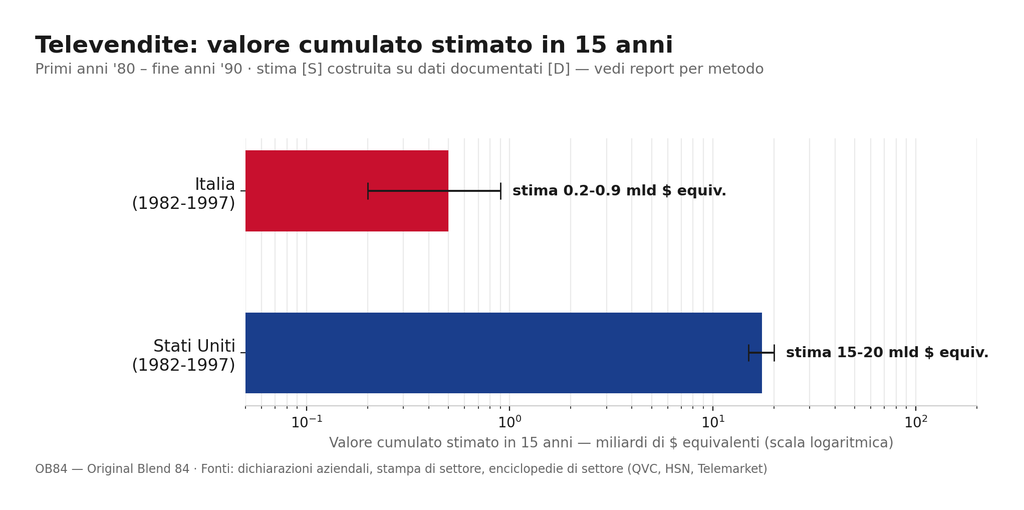
Combining documented data on HSN and QVC — from QVC’s $112 million in its first year (1986) to a ~$3 billion/year industry by the mid-1990s — the cumulative value of the US industry over these 15 years can be estimated at roughly $15-20 billion overall. In Italy, where no player ever reached QVC’s scale and no official aggregate data exists, a conservative estimate places the cumulative total at roughly a few hundred million euros — an order of magnitude below the United States over the same span.
What Live Commerce Is Worth Today
Here the data is far more solid and recent — though industry sources don’t always agree on the exact value, which is normal in a market moving faster than researchers can measure it.
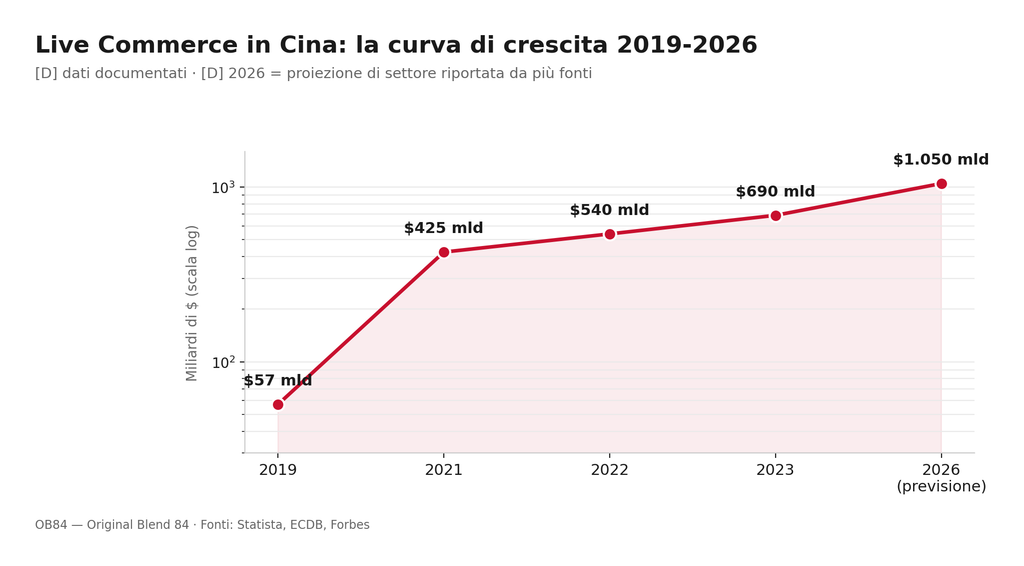
China remains the most mature market: from $57 billion in 2019 to $682-695 billion in 2023, with projections exceeding $1,000 billion by 2026. But the more interesting signal isn’t China alone — it’s that the same trajectory is repeating, a few years behind, everywhere else.

The United States is worth $35-50 billion a year today, still only about 5% of total e-commerce sales (versus roughly 60% in China) — a market at an early stage, with growth projections reaching $680 billion by 2030. Europe is worth $18.5 billion (2024), with projected annual growth of 43% through 2033. Small numbers compared to China, but exactly the point on the curve where China itself stood a few years ago — and where Italy stood with home shopping in the mid-1980s.
The Scale Leap
Here’s the comparison that, more than any other, explains why we’re talking about a shift in category, not just a new technology.

The cumulative value of 15 years of American home shopping ($17.5 billion) is now surpassed by a single year of live commerce in the United States ($42.5 billion in 2024). And it’s literally dwarfed by a single year of live commerce in China (~$690 billion in 2023) — roughly 35-40 times that historical 15-year total.
What the Live Commerce Numbers Really Say
What follows is a judgment, not a guaranteed forecast — written with the same honesty we’ve used throughout this site: no promises, just reasoning based on the numbers.
The leap between home shopping and live commerce isn’t just quantitative, it’s structural — and it’s exactly in this leap that today’s live commerce numbers make sense. Home shopping stayed tied to a physical limit — a channel, a frequency, a local or at most national audience. Live commerce inherits the same underlying logic — trust built live, product demonstration, urgency — but frees it from the channel’s limit: anyone, with the right tools, can now reach an audience that would have been unthinkable for a single local broadcaster in the 1980s.
This translates into a market that isn’t a niche looking for validation, but an already-confirmed trajectory across three different continents — with Italy and Europe today at the same stage the United States was in the mid-1980s with the first cable networks, with the advantage of being able to observe, this time, how it already played out elsewhere. Real unknowns remain: growth in Europe is still young, the sector depends on platforms that set its rules, and — just as with yesterday’s home shopping — it will be the seriousness of the operators that separates those who build something lasting from those riding a passing wave.
Looking for opportunities as Technical Crew or Testimonial/Commercial Anchor?
Discover open positions >>>